Spice Rack Organization Ideas That Actually Work
This guide contains affiliate links. If you buy through them, we may earn a small commission at no extra cost to you.
No more digging through jars — spice storage that finally fits a real kitchen. These ideas work in small kitchens, rented kitchens and big family kitchens alike, because they solve the actual problem: seeing what you have and reaching it in seconds.
1. Decant Into Matching Jars
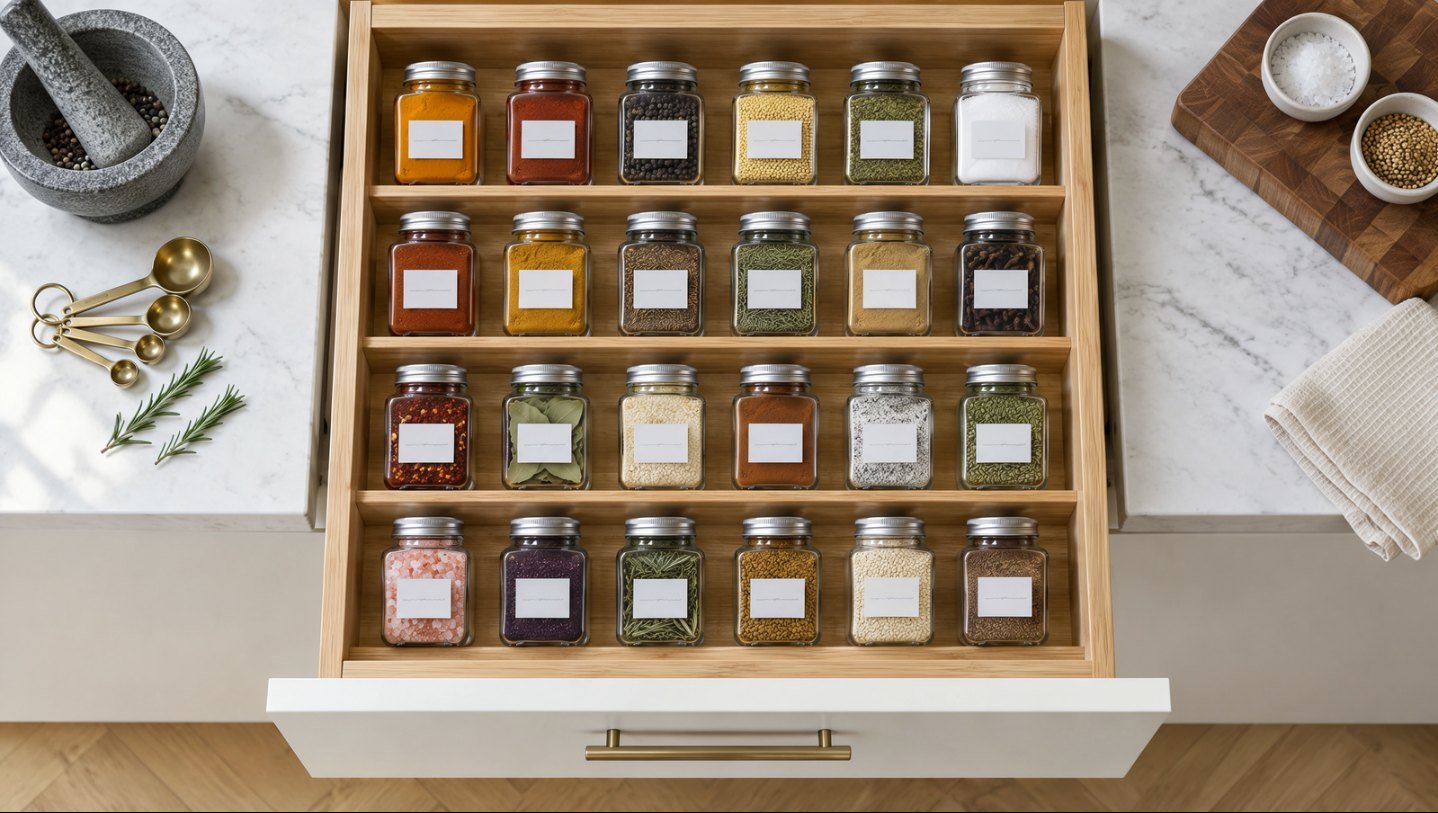
Spices arrive in a dozen different jars, bags and tins — different heights, different lids, impossible to stack. Decanting into a matched set of small glass jars (all the same size, all with the same lid) transforms a chaotic shelf into an organized one. You can see at a glance what is running low, and the jars stack and line up neatly.
Label every jar on the front (not the lid — lids get mixed up). Include the date you bought it; ground spices lose flavor after about a year.
2. Use a Drawer, Not a Cupboard
A shallow kitchen drawer beats a deep cupboard for spices. Lay jars flat in a drawer insert (or a simple angled rack), labels facing up — every spice visible at a glance, no reaching past jars to find the one at the back.
If you have a narrow drawer near the stove, that is the perfect spice drawer. It keeps spices close to where you cook and frees a whole cupboard shelf.
3. A Pull-Out Rack Inside the Cupboard
Deep cupboards hide spices at the back. A pull-out rack or sliding organizer brings the whole collection into view and reach with one pull. It fits most standard cupboards and installs with a few screws — and it ends the duplicate-buying problem (no more owning three jars of cumin).
4. Magnetic Jars on the Fridge or a Wall Strip
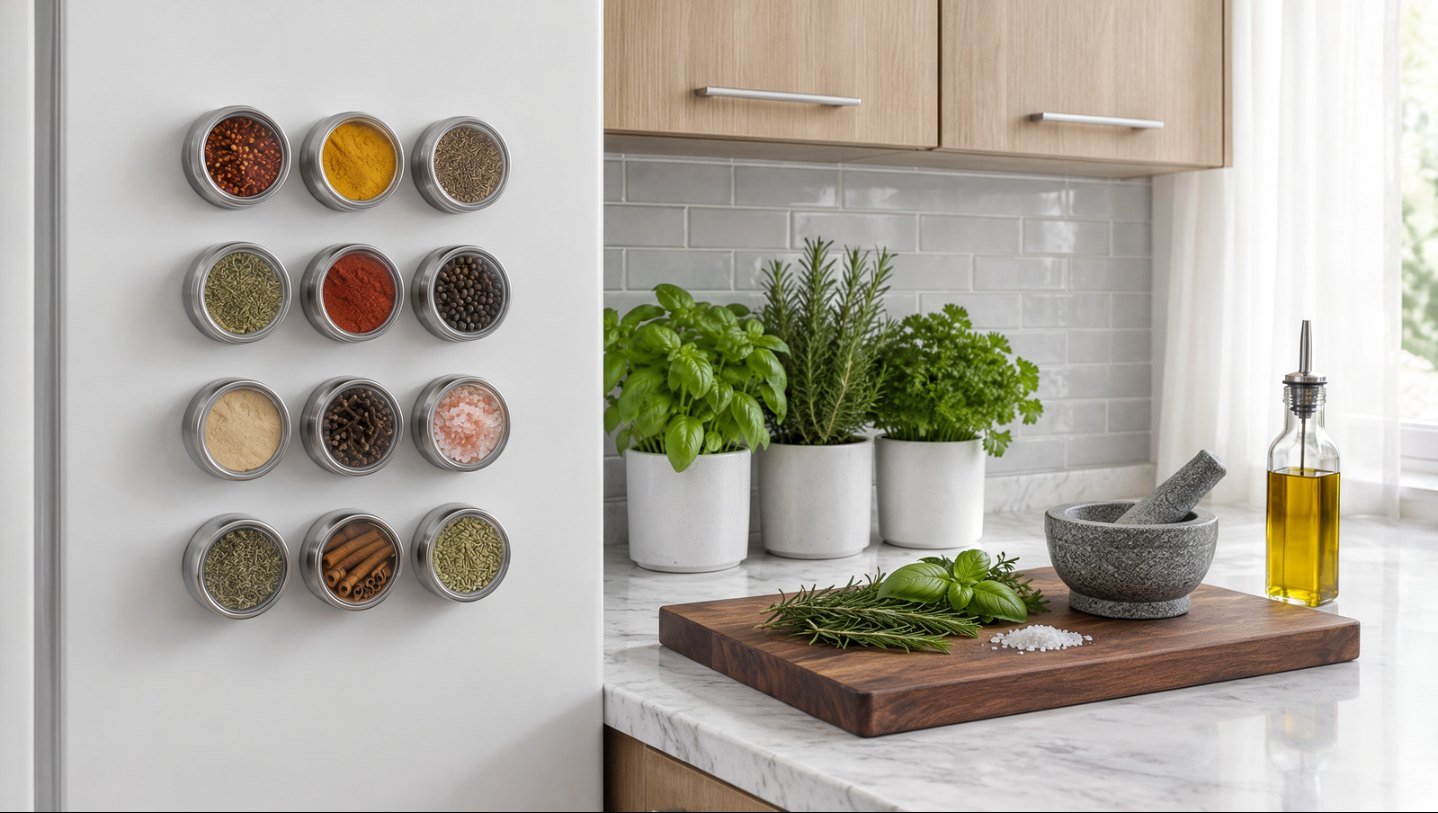
Small magnetic jars stick to the fridge door or a wall-mounted metal strip, freeing cupboard and drawer space entirely. They work best for the 8–10 spices you use most — the everyday rotation, not the whole collection.
Keep them away from the stove: heat and light degrade spices faster than anything else.
5. A Door-Mounted Rack
The inside of a pantry or cupboard door holds a surprising amount: two or three tiers of small jars, plus space for oils and sauces. It turns dead space into one of the most-used storage spots in the kitchen, and it costs less than a takeaway dinner.
6. Group by How You Cook, Not by Alphabet
Alphabetical looks tidy but does not match how you cook. Group spices by cuisine instead: an Indian group (cumin, coriander, turmeric, garam masala), an Italian group (oregano, basil, chilli flakes), a baking group (cinnamon, nutmeg, vanilla). You reach for a group, not a single jar, and cooking gets faster.
7. The One-In, One-Out Rule
Spices multiply. Every new recipe adds a jar, and old jars linger for years. Once a year, check every jar: smell it — if it has no aroma, it has no flavor, and it goes. Keep the collection to what you actually use, and the organization maintains itself.
🛒 Shop this guide
Compare current options, ratings and prices on Amazon for the items covered above.
As an Amazon Associate, Deals Cluster earns from qualifying purchases. Read our disclosure.
Frequently Asked Questions
What is the best way to organize spices?
Decant spices into matching jars, label the lids or fronts, and store them in a drawer insert or pull-out rack so every label is visible at a glance.
Should spices be stored in a drawer or a cabinet?
A drawer is usually better: you can see every jar from above, and spices stay away from the heat and light that fade their flavor.
How long do ground spices last?
Most ground spices keep good flavor for about six months to a year. Whole spices last longer, often two years or more, if stored airtight away from heat.
The Bottom Line
Start with matching jars and a drawer or pull-out rack — the two changes with the biggest payoff. Group by cuisine, label everything, and cull once a year. A tidy spice collection is not about looking good; it is about cooking faster and wasting less.
Found this guide useful? Save it to your kitchen board on Pinterest — and check our other kitchen guides for more honest, budget-friendly picks.
More from Deals Cluster: